
The first time
You cannot really prepare for it. People describe it, you sit through the briefings, and then you flip them down and it is still something else entirely. Magical is the word I would use, and I do not often use that word about equipment.
The thing to understand first is what the goggles actually do. They do not create light. They amplify the light that is already out there, and out in the real world there is almost always some. Starlight. Moonlight. A town forty kilometres away throwing glow onto the underside of a cloud. In a sealed room the goggles show you nothing at all. Outside, they nearly always show you something.
How much is the entire story. A clear night with a full moon is a different job from the darkest overcast night in November. Same aircraft, same goggles, same crew. Not the same flight.
What you actually see
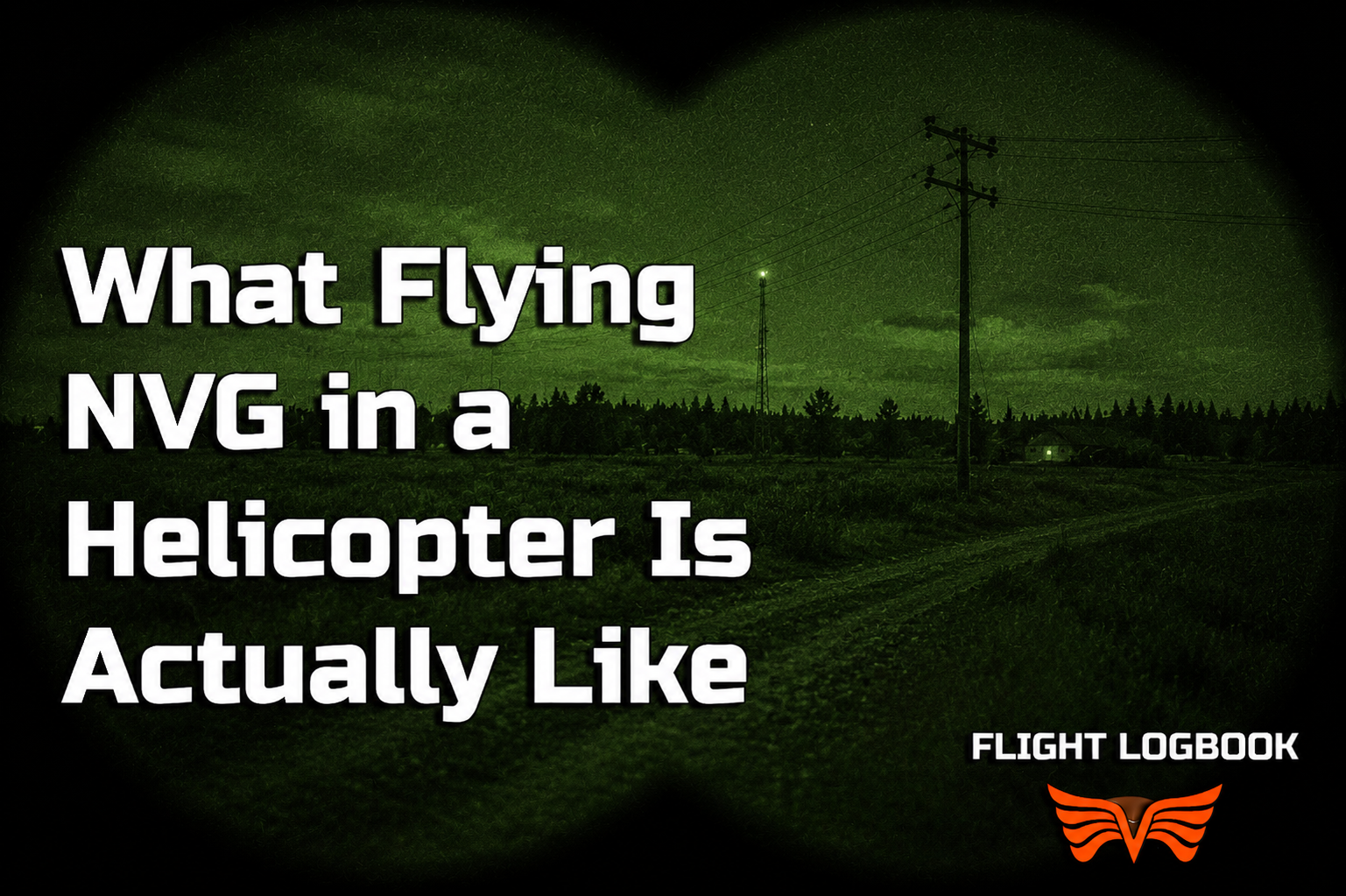
I flew on goggles thirteen years ago, and the set I used was green. Not green as in tinted. Green as in that was the only colour there was: a black and white picture rendered in shades of green, and how grainy it looked depended entirely on how much light there was to amplify. Equipment has moved on since then. The geometry has not.
Two things go away, and you have to build both of them yourself.
Depth is the first. It is simply gone. You are looking at a flat canvas, and you construct the third dimension in your head from what you know: how big that thing ought to be, how it moves against the background, how fast it grows. You are doing geometry, continuously, in the background, while flying a helicopter.
Field of view is the second. Tunnel vision deluxe. The goggles give you a narrow cone and nothing outside it, so your head never stops moving. You scan, back and forth, all night.
The thing nobody can tell you
Risk gets talked about a great deal during training, and that part is done properly. But some things do not transfer as words, and this was mine.
It is genuinely hard for the brain to accept that the picture in front of you is a real place. It looks like a canvas. It behaves like a screen. And it is a three-dimensional world you are moving through at speed, with your life as the stake. Knowing that and feeling it are not the same thing, and the gap between them closes slowly, with hours.
Where it gets hard
Landing in unfamiliar terrain. That is the one.
You do not simply arrive and put it down. You overfly the site several times, from different directions, because light falls differently depending on where you look from. Terrain that reads flat from one side shows itself from another. And the whole time you are hunting for the things that do not want to be seen: power lines, masts, guy wires.
The other hard part is smaller and constant. You look through the goggles at the world, then beside them at the instruments, then back again. Two parallel worlds, different scales, different rules, and your brain has to keep them matched. It is tiring in a way that does not announce itself until afterwards.
The mast
One night, a landing in unfamiliar terrain, very little natural light to work with.
There was a mast. Its lighting was broken. Had it been working we would have seen it from miles out, which is the entire reason masts have lights on them. We found it late, and close. We were flying at about a hundred feet, and the mast stood roughly twice that.
Here is the part that stayed with me. When you finally do see it, it is not dramatic. It does not loom. It stands there quietly, minding its own business.
It is a murder weapon, waiting.
A note on logging it
NVG time is not the same as night time, and the two big rule sets treat it differently.
Under FAA rules it is its own category. You log it for the time the goggles are your primary visual reference of the surface, during a night vision goggle operation, which runs from one hour after sunset to one hour before sunrise. That is not the same as the time the goggles are down. Down but flying on instruments is not the goggles being your primary reference of the surface.
Under EASA there is no separate goggle column. The flight is night flight time like any other, and NVIS flights and hours go in the remarks column, column 12 in the standard layout. The detail sits in the guidance material to Part-SPA rather than in the licensing rules.
So the same flight produces a number in a dedicated column on one side of the Atlantic and a note in the margin on the other. If you fly under both, or expect to convert, decide early how you are going to record it and stay consistent. The flight logging guidelines cover the general principles.
In Flight Logbook there is a dedicated NVG field, so the time goes in once and comes out in whichever format you need. That solves the recording. It does not solve the judgement: only you know when the goggles were actually your primary reference of the surface, and that call is still yours to make at the end of the flight.
If you are about to start
Good luck.
The US president raged at NATO allies over defense spending in meeting with the German chancellor, as Israel ordered its military to ‘advance’ in Lebanon